


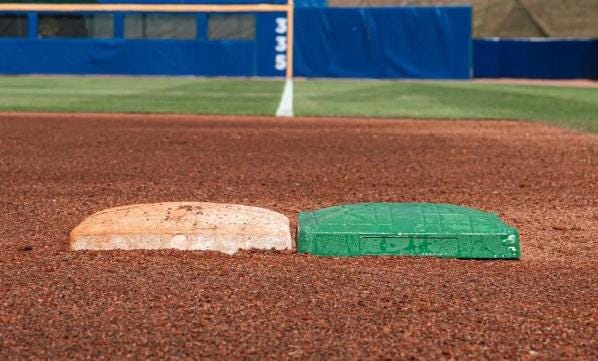
Arkansas high school baseball teams will have more flexibility at first base beginning with the 2027 season as the Arkansas Activities Association adopts a series of rule changes approved by the National Federation of State High School Associations.
Among the most notable changes is a new option allowing schools to use either an 18-inch first base or a double first base, both of which are designed to reduce collisions between runners and fielders while maintaining the integrity of the game.
Arkansas Activities Association Associate Executive Director Bobby Swofford said Arkansas schools will follow the NFHS rule changes.
“Yes, we follow 100% of the NFHS rules,” Swofford said. “This will allow schools to use either the double bag or the larger bag at first base.”
The double first base had previously been approved for use beginning in 2027, but the updated rule now gives schools the flexibility to choose either safety base option based on their facilities and resources.
The NFHS said both designs have proven effective in reducing player collisions and enhancing safety at first base.
“The NFHS Baseball Rules Committee believes that providing schools with the option of using either an 18-inch first base or a double first base gives administrators the flexibility to enhance player safety while recognizing the varying needs and resources of member schools,” said Elliot Hopkins, NFHS director of sports and liaison to the Baseball Rules Committee. “Both options are designed to reduce the potential for collisions at first base and support a reduced-risk playing environment without changing the fundamental nature of the game.”
Several additional rule changes will also take effect during the 2027 season.
Coaches will now be permitted to use one-way electronic communication with either the pitcher or catcher to call pitches while remaining in the dugout or bench area. Previously, only the catcher could receive electronic communication from the coach.
Players on the field, however, will continue to be prohibited from using electronic devices such as headphones, wireless communication devices or equipment capable of recording, streaming or transmitting audio or video, except for the approved coach-to-player communication system. Medical devices remain exempt.
Coaches will also be allowed to use handheld electronic scoring devices while in the coach’s box.
The NFHS approved an optional extra-inning tiebreaker that allows games tied after regulation to begin each half-inning with a runner on second base. The runner will be the player scheduled to bat last in that half-inning.
Another equipment change requires eye black to consist of a single solid stroke. Decorative eye black containing words, numbers, logos or other symbols will no longer be permitted.
Looking ahead to 2028, the NFHS also approved expanded bat standards. In addition to bats meeting the current USA Baseball BBCOR .50 standard, certain certified drop-4, drop-5 and drop-6 non-wood bats will also be permitted, provided they display the required permanent certification mark.
“In addition, the NFHS remains committed to fostering the growth and development of high school baseball players,” Hopkins said. “As the game continues to evolve with the adoption of the USA Baseball BBCOR standard, expanding the available drop-weight options provides younger and developing players with additional opportunities to build proper mechanics, confidence and skills while maintaining the safety and performance standards expected in education-based athletics.”
According to the NFHS 2024-25 High School Athletics Participation Survey, baseball remains the nation’s fifth-most popular boys sport with 472,598 participants at 16,110 schools. An additional 1,381 girls also participated in high school baseball during the same school year.